

Program Description
Building Assets Reducing Risks (BARR) is a training and coaching model that serves K–12 schools with a structured system and tools to improve student outcomes. Grounded in two core pillars – Relationships and Data – BARR strengthens staff-student, staff-staff, and student-student relationships while embedding the consistent use of academic and non-academic data into daily practice. BARR strategies include teacher teams meeting regularly to discuss each student’s strengths and progress and identify obstacles to learning. Community Connect meetings are designed to implement comprehensive strategies to address the needs of the students who need resources outside of school for enrichment and support. Extensive professional development and coaching are provided to teachers and school leaders. Family engagement is key to BARR implementation.
Program Outcomes
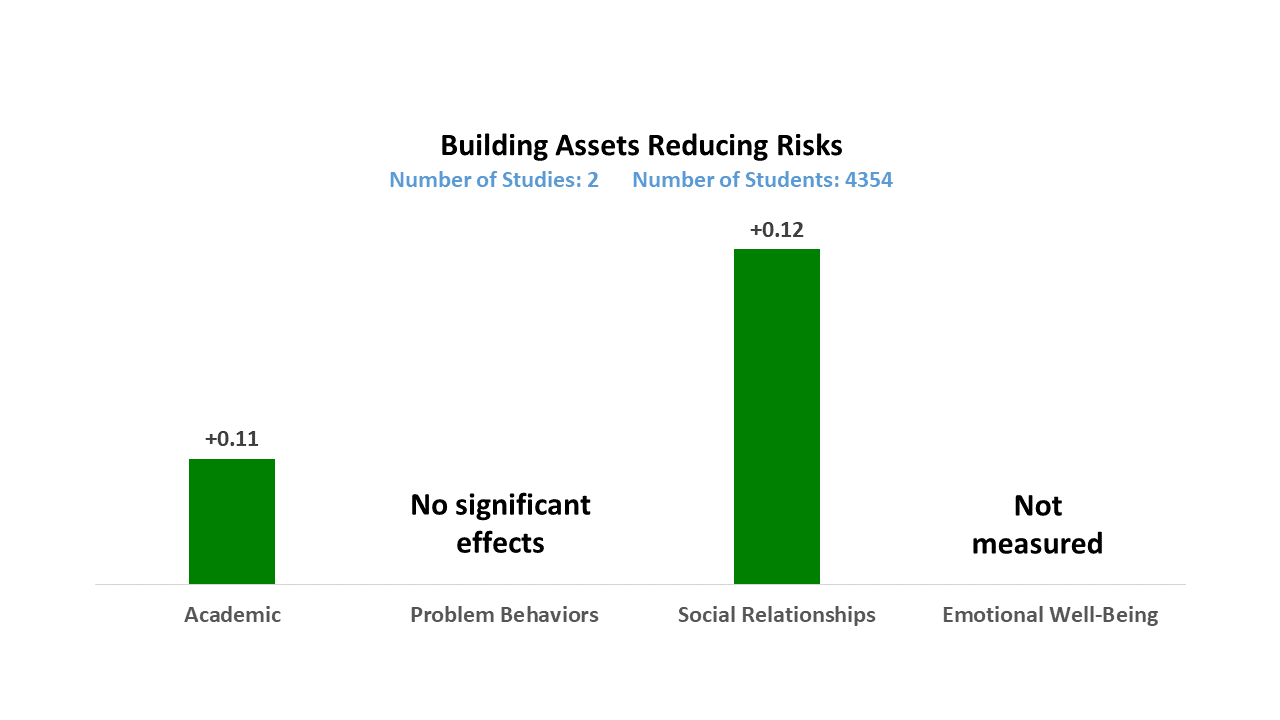
A study of BARR was carried out as part of a federal Investing in Innovation grant (Corsello & Sharma, 2015) involving one school in a high poverty suburb in Southern California. Within this school, students were randomly assigned to BARR or control conditions. Only students in self-contained special education or those with very limited English proficiency were excluded from random assignment. The student racial composition was 55% White, 37% Hispanic, and 11% Other. 68% of students were eligible for free- or reduced-price lunches, and 17% were English learners. On NWEA standardized tests, controlling for pretests, BARR students gained significantly more than controls and also earned significantly higher GPAs and number of credits in core courses for an average effect size of +0.23. This qualified BARR for a “Strong” rating in the Academic category.
In another study, Bos et al. (2019) evaluated BARR in 11 high schools from 5 states. The sample included 55% Hispanic, 25% White, 9% African American, and 32% English learner students. Also, 77% of the students were receiving free- or reduced- price lunch. Approximately 30% to 50% of students in each school were randomly assigned to the intervention group, and the remaining students were assigned to the control group. After 1 year of intervention, BARR students demonstrated stronger student-teacher relationships and sense of belonging to classroom than control students (ES=+0.17). Students in the BARR group also had significantly higher GPAs and were significantly less likely to fail courses than control students (ES=+0.21), but did not gain more than controls on NWEA reading or math scales (ES=+0.01). BARR students tended to be more engaged in academic affairs than control students as well, showing greater levels of grit, belief in teachers’ expectations, persistence in school, and attendance (ES=+0.09). These findings solidified BARR’s “Strong” level in the Academic category and also qualified BARR for the “Strong” level for Social Relationships.
Staffing Requirements
A staff member needs to be selected to serve as the school’s coordinator for the BARR model. The coordinator can be an assistant principal, school counselor, teacher, or another staff member. The coordinator will manage, coordinate, and integrate the BARR model. He or she works with school staff, administrators, and parents/guardians to support the needs of all students. Teams of teachers need to meet weekly using the BARR process.
Professional Development/Training
Professional Development
Each BARR school will receive two days of in-person professional development annually delivered through a sequenced, multi-year training plan. Each training session uses BARR materials and practice.
In Year 1, training will focus on implementing the BARR model; in Years 2 and 3, training will address advanced implementation topics, including effective team meetings, understanding trauma, reducing risky behaviors, and fostering student resilience.
The BARR coordinator and the school administrator are also invited to participate in quarterly Professional Learning Community (PLC) calls to connect with other schools across the country that are implementing the model and to attend the annual BARR National Conference.
Coaching
Each school will also be assigned a dedicated BARR coach who provides ongoing implementation support through structured weekly coaching sessions and quarterly on-site visits. Schools receive an average of more than 200 hours per year of personalized coaching and technical assistance, with direct support to the BARR Coordinator and school leadership to monitor implementation, address challenges, and support continuous improvement and long-term sustainability.
Technology
None needed